


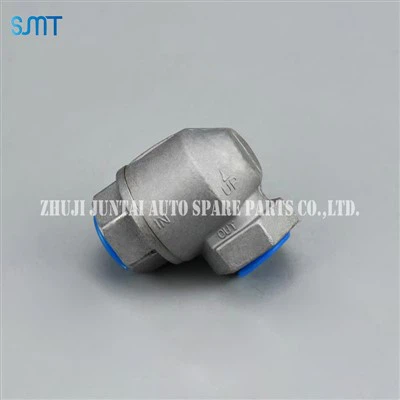
Single Check Valve
The Single Check Valve Manufacturer!
Zhuji Juntai Auto Spare Parts Co.,Ltd. was established in 2011 and located in Zhuji City, Zhejiang Province, China. Our factory has professional technicians team and excellent sales team, which can help us to provide our clients good quality and perfect service.




Why choose us
Excellent Team
Our factory has professional technicians team and excellent sales team, which can help us to provide our clients good quality and perfect service.
Quality Assurance
ISO 9000 certificate of conformity of quality management system certification; certificate of utility model patent; SGS gold plus supplier assessment certificate.
Reputation
A company with a positive reputation is more likely to attract customers. Reputation is built through consistent quality service or products, good customer relations, and reliability.
Production Market
Our products are exported to over 100 countries in Southeast Asia, Europe, Africa, America, and other regions, as well as domestic automotive after-sales markets and repair shops. The annual transaction volume exceeds 20 million yuan.
|
Type |
SINGLE CHECK VALVE |
|
Place of Origin |
Zhejiang, China |
|
Purpose |
For replace/repair |
|
OE NO. |
107800 |
|
Material |
Copper |
|
Application |
AIR HANDLING SYSTEM |
|
Gross Weight |
14.34 KGS |
|
Net Weight |
13 KGS |
|
Packing Quantity |
50 PCS/CTN |
|
Package Dimensions |
33 CM*25 CM*19 CM |
Components of Single Check Valve
Valve body
The robust housing that connects to the pipeline and withstands system pressure.
Spool/disc/ball
The movable element that opens when forward flow exceeds a certain pressure and closes when flow stops or reverses.
Spring
Ensures the valve remains closed under low pressure and provides a set cracking pressure before opening.


Ball Check Valve
Design: A small ball (stainless steel, brass, or PTFE) sits in a tapered seat. Forward flow lifts the ball; reverse flow seats it tightly.
Best For: Low-pressure systems (e.g., drinking water lines, aquarium pumps), small spaces (lab equipment), and viscous fluids (oil, syrup).
Swing Check Valve
Design: A hinged, flap-like disc swings open with forward flow and slams shut when flow reverses.
Best For: Large-diameter pipes (2”+), high-flow systems (municipal water lines, oil pipelines), and low-cost industrial applications.
Lift Check Valve
Design: A piston or plug lifts vertically off the seat with forward flow, guided by a stem.
Best For: High-pressure steam systems, boilers, and applications where tight sealing is critical (e.g., power plants).
Diaphragm Check Valve
Design: A flexible diaphragm (rubber or PTFE) bends to allow flow, then flexes back to block reverse flow.
Best For: Sanitary applications (food, pharmaceuticals), low-pressure gases, and fluids with particles (prevents clogging).
Industrial Applications
In industrial settings, one-way valves are essential in maintaining the integrity of fluid systems. They are commonly used in:
Oil and Gas: Check valves prevent backflow in pipelines, ensuring efficient transport of hydrocarbons.
Water Treatment: They are used in various stages of water purification processes to maintain unidirectional flow.
Medical Applications
One-way valves play a significant role in the medical field. For instance:
IV Sets: They prevent backflow of blood or fluids, ensuring safe and effective delivery.
Respiratory Equipment: Used in devices such as ventilators to control airflow direction.
Agricultural Applications
In agriculture, one-way valves are utilized in irrigation systems to:
Prevent backflow of water, which could contaminate clean water supplies.
Ensure efficient water delivery to crops, enhancing growth and yield.

Installation considerations of One-way valve
Sealing check : After installation, a comprehensive sealing check should be performed on the connection between the check valve and the pipeline. This can be done by applying soapy water or a special leak detection fluid to observe whether there are bubbles or abnormal leaks. For high-pressure systems, it may be necessary to use professional pressure testing equipment to verify the sealing performance.
Vibration control : In some applications, the check valve may produce significant vibration. To reduce this vibration, the following measures can be taken:
Use flexible connectors or vibration dampers to connect the check valve and the pipeline system
Install a damper or muffler near the check valve
Adjust the spring preload of the check valve as needed
Bypass installation : In some critical systems, it is recommended to install a manual bypass valve next to the check valve. The benefits of doing so include:
Convenient emergency operation
When the check valve needs to be repaired or replaced, the entire system can be operated without stopping
Improving the overall reliability and safety of the system
Pipeline support: For large or heavy check valves, sufficient pipeline support should be provided near the installation location. Reasonable support can not only reduce the stress on the check valve, but also reduce the vibration of the pipeline system, thereby improving the stability and life of the entire system.
Electrical connection: For check valves with electrical control functions (such as electric check valves), the following points should be noted:
Install lightning protection and surge protection devices when necessary
Make sure that the electrical connection meets the relevant safety standards
Use cables and connectors of appropriate specifications
Packing And Shipping
