


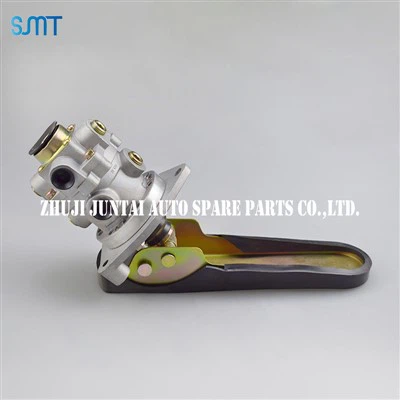
Air Brake Valve
In a truck's air brake system, air brake valves get a signal when a driver presses the treadle, which then opens the valve and allows air to enter the brake chamber via air inlet. The diaphragm gets pushed, then the rod, then the slack adjuster which twists to turn the brake camshaft.
Benefits of Air Brake Valve
Since air brake valve run on air, minor leaks can be mitigated as more air is drawn in through the compressor. As a result, the system can still function in a capacity with a small leak. This differs from hydraulic systems where leaks result in continual losses with no fluid replacing what is lost.
Unlike hydraulic fluid, air can be compressed and energy can be stored. This is useful when the compressor fails, as it allows enough air pressure stored in the air tank to operate the brake chamber, even though no more air is being drawn in and compressed.
Air brake valve can continue to work effectively even with significant leakage in the brake lines. Air brake valves are also typically designed with a mechanical fail-safe that stops the vehicle safely using the parking brake in the event of failure.
Compressed air can also be utilized for accessories, such as air horns and seat adjusters. In a pinch, the engine mounted compressor can also be used to add additional PSI to a low tire, though doing so can damage your compressor.
Air hose couplings are easier to install and maintain when compared to hydraulic lines. You also don't need to “bleed” air brake valve as part of maintenance.
Easier to couple to and uncouple from trailers. Air brake valves are especially practical when in applications where trailers and constantly attached and removed.




Why Choose us
Excellent team
Our factory has professional technicians team and excellent sales team, which can help us to provide our clients good quality and perfect service.
Quality Assurance
ISO 9000 certificate of conformity of quality management system certification; certificate of utility model patent; SGS gold plus supplier assessment certificate.
Reputation
A company with a positive reputation is more likely to attract customers. Reputation is built through consistent quality service or products, good customer relations, and reliability.
Air Brake Valve in Different Types of Vehicles
Air brake valve in cars
Air brake systems, while commonly associated with larger commercial vehicles like trucks and buses, are not typically found in standard passenger cars. Instead, passenger cars predominantly utilize hydraulic brake systems. These systems operate using brake fluid to transfer force from the brake pedal to the brake pads or shoes, creating friction to slow or stop the vehicle.
Air brake valve in buses
When it comes to the safety and functionality of buses, especially those of substantial size and weight, air brake valve are extremely important. Buses, like heavy trucks, commonly utilize air brake systems due to their efficiency in managing the significant braking demands posed by these vehicles.
Air brake valve in trucks
Integral to the safe operation of trucks, air brake valve play a crucial role in managing the substantial weight and stopping power required for these heavy vehicles. Trucks commonly employ air brake systems due to their ability to handle the demanding braking needs imposed by their size and load capacities.
Air brake valve in semitrucks
Air brake systems serve as the backbone of safety and control in semitrucks, providing the necessary braking force to manage their immense size and weight. Semitrucks extensively rely on air brake systems, which are vital for ensuring the safety of operation, particularly when navigating highways while hauling heavy loads.
How Air Brake Valve Work
Air brake valve on trucks work using compressed air instead of hydraulic fluid. Air brake valve can be either drum brakes or disc brakes, or a combination of both.
Air is pressurized by an engine-mounted compressor. The air compressor then pumps the air into the air storage tanks, which store the compressed air until it’s needed.
Air pressure is used to apply the service brakes and release the parking brake. There are multiple air circuits in the system. The parking brake engages by spring force in the parking brake portion of the spring brake chamber when the air pressure in the chamber is released.
This also allows the parking brake to be used as the emergency brake system. If air pressure was to drop too low, the force exerted by the spring in the chamber will be able to overcome the force exerted by the air on the diaphragm and apply the brakes on all wheels.
You might think of air brake valve as working similarly to a hydraulic brake circuit. As with hydraulic brakes, air pressure is applied when the driver presses the brake pedal.
Air Brake Valve vs. Hydraulic Brakes
Aside from stopping the vehicle, there are very few similarities between air and hydraulic systems. Here's how each system is different.
Hydraulic Brakes
Hydraulic oil is used to operate the brakes. The system's main components include the oil reservoir, wheel cylinders, and master cylinder. It's designed for light-duty vehicles, such as passenger cars, SUVs, and trucks. A hydraulic system isn't nearly as powerful as air brake valve. Engine power is not needed to run the hydraulic brakes, and the system is self-lubricating.
Air Brake Valve
Instead of hydraulic fluid, compressed air operates the brakes. It's a more robust system, which is why it's used on heavy-duty vehicles. Air brake valves are not self-lubricating. Engine power is needed to run the air compressor. The main components include the chamber, brake valve, unloader valve, and compressor.

There are two types of adjusters: manual slack and automatic slack. Adjustment instructions depend on which one you work with.
A system with a manual slack adjuster is the most common type. Read the service manual for exact instructions, or follow these steps.
Find the slack adjuster. The manual slack adjuster is a flat knob or handle on the side of the brake chamber. It's usually on the left side.
Tighten the adjuster. Jack up the truck. Press and hold the spring-loaded locking sleeve. Turn to tighten the slack adjustment.
Adjust the bolt, but don't push the pushrod from its chamber. Stop once it reaches its maximum stiffness. Leave room between the drum and the linings.
Double-check the slack adjuster. Examine the distance from the exit point of the pushrod to the brake chamber face.
Once you are done with the adjustment, lower your truck. When you start driving again, go slow and get a feel for the adjustments.
If your rig has automatic slack adjusters, there's no reason to make manual alignment adjustments. However, to avoid problems, you should have a mechanic check the system every 25,000 to 50,000 miles.
Drivers of vehicles with air brake valves are required by law to check the system before every trip. If you discover an issue, you should always contact a professional. Fixing these systems isn't as simple as changing the pads.
Air Brake Valve Inspection And Preventive Maintenance
After inspecting and maintaining air brake valves for years and years, I have devised this inspection and preventive maintenance module for air brake valves. You can appraise your braking system like an expert by using the method. All you need is a set of wheel chocks and a timer to carry out this inspection.
Check the Low-Air Warning
Your brake system must maintain pressure above 55psi. When the pressure drops down from there, the law-air warning indicator in the odometer or the dashboard starts blipping. A low-air warning indicates a huge leakage or failure of the compressor.
Check Air Pressure Build-up
You do this test to check the air compressor. Rev up the engine between 600-900rpm. Lower the air pressure to 85psi by pushing down the brake paddle. Now, set your eyes on the pressure gauge. The air pressure should get back to its original value within 100-120 seconds with an optimally working compressor.
Check Compressor Governor Cut-out and Cut-in
- This test makes sure the compressor governor is regulating the compressed air with precise cut-ins and cut-outs. Rev up the engine and let the brake pressure build-up. Keep your eyes on the gauge and ears on the hissing sound. If your brakes hiss at any value between 100 and 145psi, your brake governor is cutting out the air pressure at the right value. The right cut-out is essential to prevent pressure build-up and subsequent damages in the brake chambers.
- For the cut-in test, press down the paddle to lower down the pressure to 25psi. Then monitor the gauge needle. If it starts moving up and reaches 80psi, it means the compressor governor is pushing the compressed air to the tank and creating the required braking pressure.
- If the governor is not cutting in and out of the compressed air for the right pressures, you need to go to the brake specialists instead of driving the vehicle as-is. A faulty governor doesn't result in brakes' complete failure, but it can significantly cut down its efficiency.
Check Air Valves
Inspect all air/brake valves of the system for leaks. You can use soap water with a spray bottle to identify them. If you stumble upon a leak creating large bubbles, you need to replace the given valve as soon as possible.
Check Brake Lining
Inspect the lining of brake shoes and pads for wear and tear and accumulation of oil, grease, and mud. If it has excessively worn out or the build-up has baked on its surface, you need to replace the lining.
Lubricate Slack Adjusters
Lubricate slack adjusters when you lubricate the vehicle chassis. You need to do it every three months or after completing 5,000 miles.
Company Introduction
Zhuji Juntai Auto Spare Parts Co.,Ltd. was established in 2011 and located in Zhuji City, Zhejiang Province, China. Our factory has professional technicians team and excellent sales team, which can help us to provide our clients good quality and perfect service.
Our two main products are: Brake valves such as clutch servos, air dryer, levelling valves and some other valves; Lubrication system parts like grease gun, fittings and valve.

Our Certificates


