


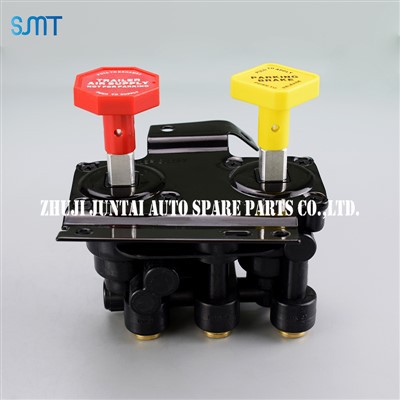
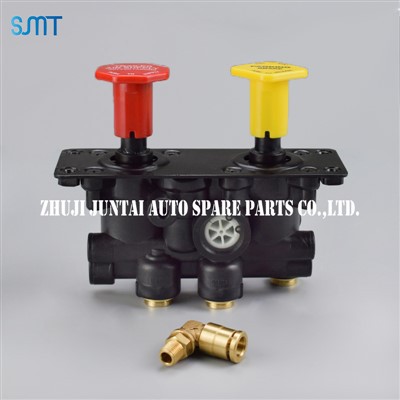
Control Valve
Zhuji Juntai Auto Spare Parts Co.,Ltd is Brake valves such as clutch servos, air dryer, levelling valves and some other valves; Lubrication system parts like grease gun, fittings and valve.






Why choose us
Production Equipment
CNC Process Center; Sandblasting machine, CNC lathe, drilling machine, lifter, crimping machine, computer digital display test bench, assemble product line.
Production Market
Our products are exported to over 100 countries in Southeast Asia, Europe, Africa, America, and other regions, as well as domestic automotive after-sales markets and repair shops. The annual transaction volume exceeds 20 million yuan.
Our Service
We have a professional sales team who can answer various inquiries from customers about our products.
| Valve Size | Valve size is the designated size of the valve by manufacturer. This typically represents the size of the passage opening. | |
| Search Logic: | User may specify either, both, or neither of the "At Least" and "No More Than" values. Products returned as matches will meet all specified criteria. | |
| Pressure Rating | Maximum safe pressure value for which the valve is rated. | |
| Search Logic: | User may specify either, both, or neither of the "At Least" and "No More Than" values. Products returned as matches will meet all specified criteria. | |
| Number of Ports/Ways | Represents the number of connections or inlet / outlet ports to the valve. | |
| Search Logic: | User may specify either, both, or neither of the "At Least" and "No More Than" values. Products returned as matches will meet all specified criteria. | |

What are the different types of control valves
The linear globe valves are linear motion closing-down valves used to start, stop or regulate the flow using a closure member referred as plug.
The linear angle valves are the next variety, and this valve has an inlet and an outlet port which are perpendicular to each other. This type of control valve is usually used to control the flow of abrasive liquids or high velocity fluids, in a pipe. These valves can deal with high noises and increased pressure drops.
A rotary valve is the third variety and here the fluid flow is regulated through the rotation of passages present in a transverse plug. Are you transferring fluids that contain some bit of solid? These valves are designed for such applications.
The linear three-way control valve is the fourth variety and this type of control valve features two outlets & one inlet or one inlet & two outlets. This valve will be perfect in an environment where there will be a need to mix or divert liquids. Such valves are useful in fan coils and air handling units.
The benefits of a control valve
Automatic Operation
One of the most important benefits offered by a control valve is that it controls the opening and closing process of a fluid automatically.the users don't have to be careful about closing or opening the valves manually, when these types of valves are employed.
Easy Installation
Another great advantage of control valves is that they are absolutely easy to install. Many people can effortlessly install these valves on their faucets without having to call for assistance from a plumber or from the manufacturer. Thus, being easy to install, they help in saving the time and effort of the users.
Reduced Wastage
Due to the automatic operations of these valves, there is a great reduction in the wastage of resources. No matter whether these are being used in industrial or manufacturing processes, or at homes, they will ensure less wastage of resources, thanks to their efficient working.
Popular Applications of Control Valves in the Industry
Control valves regulate the flow in loops.
1
>>
At the start of the loop, a transmitter and a controller compare the current flow level with the desired level.
2
>>
The controller sends a correction signal to the control device (valve).
3
>>
The control valve closes to reduce the fluid flow (or opens to increase it).
4
>>
The valve opens or closes to ensure the desired level of flow.
5
Control Valve Sizing Example
Fluid: Water.
Inlet Temperature: 363K.
Fluid Density: 965.4 kg/m3.
Inlet Absolute Pressure
680 kPa.
Outlet Absolute Pressure
220 kPa.
Flow Rate (Q)
360 m3/h.
Pipe Size
150mm.
Packing and Shipping

Our factory
Our factory has professional technicians team and excellent sales team, which can help us to provide our clients good quality and perfect service.

Certification
ISO 9000 certificate of conformity of quality management system certification; certificate of utility model patent; SGS gold plus supplier assessment certificate.


